Cartagena has been around for over 480 years, and it shows — not in a heavy or museum-like way, but in the details. The thickness of the walls in the colonial houses, the logic of the Historic Center’s street layout, the scale of the fortifications facing the sea. Understanding something of what happened here changes the way you move through the city. What looks like decoration has history behind it, and that history has names, dates and consequences that reach into the present.
This guide covers the main periods of Cartagena’s history: from the Spanish founding in the 16th century to the present, with emphasis on the moments that left a visible mark on the city as it exists today. It’s not an academic text — it’s context for travelers who want to understand what they’re looking at when they walk the Historic Center, climb the walls or visit Castillo de San Felipe.
Quick answer
When was Cartagena de Indias founded? Cartagena de Indias was founded on June 1, 1533 by Spanish conquistador Pedro de Heredia. It’s one of the oldest cities in South America.
Why is Cartagena called “de Indias”? The name refers to Cartagena, a coastal city in southeastern Spain, and “las Indias” — the name the Spanish used for the Americas. The suffix distinguishes it from its Spanish namesake.
Why was Cartagena so important during the colonial era? It was the main export port for the gold and riches of the Viceroyalty of New Granada heading to Spain. That strategic position made it a frequent target for pirates and rival European powers, which explains the massive scale of its fortifications.
The indigenous peoples before the Spanish arrived
Before the Spanish founded Cartagena, the territory was inhabited by several indigenous groups. The Turbacos and the Caribs were the most present in the region. They had settlements on the coastal islands, along the shore and inland.
The relationship between the Spanish conquistadors and these communities was violent from the start. Pedro de Heredia arrived with an army, and the founding of the city involved the displacement and subjugation of local communities. The Turbacos, in particular, resisted for years. One notable figure from this period is Catalina, an indigenous woman who spoke Spanish and served as interpreter — her story reflects the complexity of an era that doesn’t reduce to simple narratives.
The Spanish founding and the 16th century
Pedro de Heredia founded Cartagena on June 1, 1533, on the northern tip of an island separated from the mainland by a system of bays and marshlands. The location was deliberate: the inner bay provided natural protection for ships and the island made land attacks harder.
From its earliest years, Cartagena grew fast for a concrete reason: gold. The Spanish found large quantities of gold objects in indigenous burial sites throughout the region and shipped them to Spain. That turned the city into a first-order strategic point for the Spanish Crown.
By the mid-16th century, Cartagena was already the third most important port in Spanish America, after Veracruz and Nombre de Dios in Panama. The city began developing its commercial, religious and military infrastructure, though the early construction was modest compared to what came later.
Pirate attacks and the building of the walls
The 16th and 17th centuries were decades of constant attack. Cartagena had gold, had strategic position and had enemies. Pirates and corsairs — many financed by European rivals of Spain, including England and France — attacked the city repeatedly and with success.
The most well-known attack is Francis Drake’s raid in 1586. The English privateer arrived with a fleet of more than twenty ships, occupied and looted the city for weeks and only left after receiving a substantial ransom. That episode was the definitive signal that existing defenses were insufficient.
The Spanish response was monumental. Through the 17th century, they built the wall system that rings the Historic Center today — over eleven kilometers of fortification, averaging nine meters high and seventeen meters wide at the thickest points, built primarily from coral stone quarried from the bay floor.
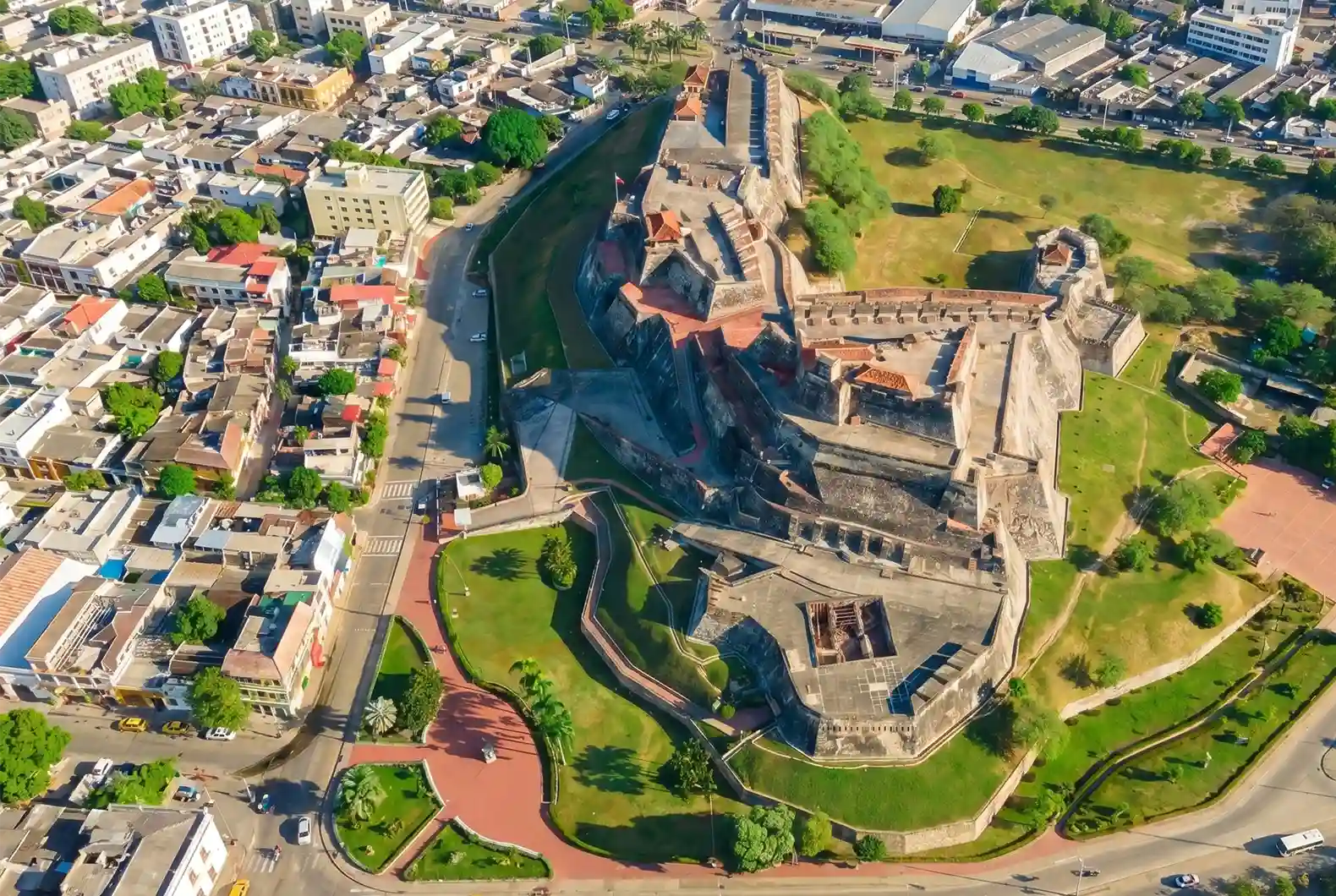
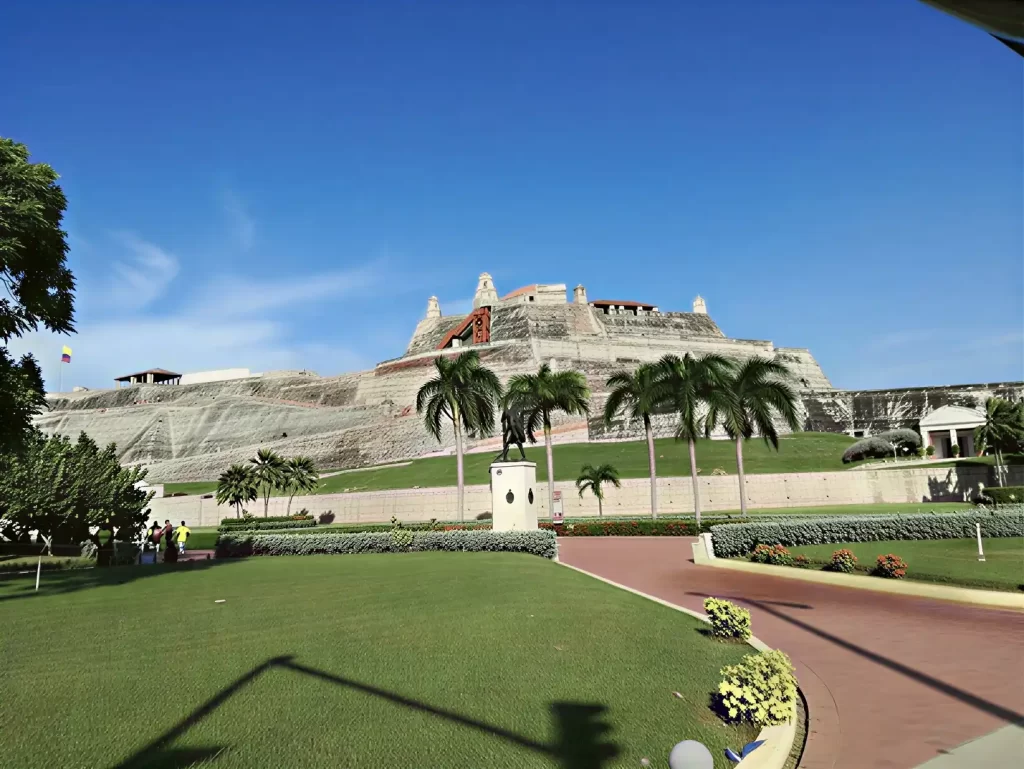
The system also included Castillo de San Felipe de Barajas, on the hill of San Lázaro, which became the largest fortress Spain ever built in the Americas. The walls were never taken by force after their construction. That says something about how seriously they were engineered.
The slave trade and the african heritage
Cartagena was the main entry port for enslaved Africans into the Viceroyalty of New Granada. During the 16th, 17th and 18th centuries, tens of thousands of people arrived here by force from various regions of Africa, sold at the city’s slave market and either kept in Cartagena or redistributed to other territories.
This history — long minimized in official narratives — is inseparable from what Cartagena is today. The city’s culture, music, cuisine, speech patterns, rhythms and religious expressions have deep African roots. Palenquero, a creole language spoken in San Basilio de Palenque, less than 45 miles from Cartagena, is the first Spanish-based creole language in the Americas and was declared an Intangible Cultural Heritage by UNESCO.
The figure of Pedro Claver — a Jesuit priest who dedicated his life to assisting the enslaved people arriving at the port — is part of this history. His home, now a museum and basilica in the Historic Center, stands across from where the slave market once operated.
Independence and the 19th century
Cartagena was the first city in the Nueva Granada to declare independence from Spain, on November 11, 1811. That’s why it’s known as “La Ciudad Heroica” — the Heroic City — a title that appears in the city’s symbols and that Cartageneros mention with genuine pride, not just protocol.
The process was anything but smooth. The independence wars left Cartagena in extremely difficult conditions. The siege imposed by Spanish commander Pablo Morillo in 1815 — known as “the hundred-day siege” — was one of the harshest episodes: the city held out for months without supplies until the situation became untenable. Thousands died of hunger and disease. Simón Bolívar called Cartagena “the martyr city” after the siege, a title that stuck.
Through much of the 19th century, Cartagena lost economic relevance compared to Barranquilla, which became the most active port on Colombia’s Caribbean coast. The city entered a period of lower activity that — paradoxically — preserved its colonial architecture. The lack of resources to demolish and rebuild conserved what draws millions of visitors today.
The 20th century and Cartagena’s transformation
The second half of the 20th century brought radical change. Tourism began to grow and the city rediscovered itself as a destination. In 1984, the UNESCO designation of the Historic Center as a World Heritage Site formalized what many already sensed: that the walls, streets and colonial buildings were an exceptional resource.
Bocagrande developed as a modern hotel district through the latter half of the 20th century. What had been a narrow strip of land between the bay and the sea became the hotel and residential zone it is today. The coexistence of the colonial Historic Center and modern Bocagrande is part of Cartagena’s current identity.
The historical sites worth visiting
Knowing Cartagena’s history makes the physical sites more legible. These are the places where that history is most visible:
- The city walls: the full perimeter can be walked on foot. At sunset, with the Caribbean on one side and the Historic Center on the other, it’s one of the most striking walks in the country.
- Castillo de San Felipe de Barajas: the largest fortress in the Americas. Its tunnels, ramps and summit view give a physical sense of the history that no book can replicate. At 15 minutes by car from Bocagrande.
- Basílica Menor de San Pedro Claver: where the Jesuit priest who assisted thousands of enslaved people lived and died. The adjacent museum has colonial artifacts and historical documentation.
- Plaza de la Aduana: the colonial administrative center. The buildings surrounding the plaza date from the colonial period.
- Iglesia de Santo Domingo: Cartagena’s oldest church, with a mixture of styles reflecting the centuries of modifications since its original construction.
For the full walk through the Historic Center, the Historic Center guide covers how to organize the visit, how long to allow and what not to miss in each neighborhood.
Cartagena today: Tourism, identity and tension
Cartagena receives millions of visitors a year and tourism is its main economic engine. That has visible consequences: the Historic Center has become more expensive, some neighborhoods have changed character and there are real tensions between tourist gentrification and the communities that have always lived in the city.
Getsemaní is the clearest example of that process: a neighborhood that was working-class for decades now has restaurant and hostel prices that its original residents can’t afford. The debate about how to preserve heritage without displacing the people who inhabit it is open and doesn’t have a clean resolution.
What is clear is that Cartagena works because it has layers. Colonial history, African heritage, contemporary popular culture and international tourism coexist in the same space — not always without friction. That tension makes it more interesting, not less.
The Hotel Regatta as a base for exploring Cartagena’s history
Bocagrande, where Hotel Regatta is located, is the modern face of Cartagena: directly on the water, with complete hotel infrastructure and easy access to everything historical. The Historic Center, the walls and Castillo de San Felipe are all minutes away. You don’t have to choose between comfort and culture — the location handles that.
The hotel has rooms with ocean views, restaurant serving breakfast from 6:30 AM, bar, rooftop pool and all the services of a 4-star hotel. For travelers who want to explore Cartagena’s history without giving up comfort, it’s a practical and well-positioned base.
Book direct with Hotel Regatta Cartagena
The best available rate, always on the hotel’s website, with no intermediary fees.
Frequently asked questions
Why is Cartagena called “la Ciudad heroica” — the heroic city?
Because of its role in Colombian independence. On November 11, 1811, Cartagena was the first city in Nueva Granada to declare independence from Spain. It then endured Morillo’s brutal siege in 1815, a period Simón Bolívar recognized by calling it “the martyr city.” The title Heroic City comes from that era.
Who built the walls of Cartagena?
The walls were built and expanded through the 17th and early 18th centuries under orders from the Spanish Crown. Several military engineers participated in the design, with Flemish engineer Juan de Herrera y Sotomayor playing a key role in major phases. The labor force consisted largely of enslaved people and indigenous workers.
When was Cartagena’s Historic Center declared a UNESCO world heritage site?
In 1984, UNESCO declared the Port, Fortresses and Group of Monuments of Cartagena a World Heritage Site. It’s one of the few colonial ensembles in the Americas that maintains its original urban layout and architecture at that scale.
Who was Pedro claver and why is he important in Cartagena?
Pedro Claver was a Spanish Jesuit priest who lived in Cartagena in the 17th century and dedicated his life to assisting the enslaved Africans arriving at the port. He is estimated to have helped over 300,000 people during his lifetime. He was canonized in 1888 and is the patron saint of Colombia. His basilica and museum are in the Historic Center.
What is Palenquero and what does it have to do with Cartagena?
Palenquero is a Spanish-based creole language mixed with African languages, spoken in San Basilio de Palenque, a community near Cartagena. It’s the first Spanish-based creole language in the Americas and was declared an Intangible Cultural Heritage by UNESCO in 2005. Cartagena was the point of arrival for most of the enslaved Africans who formed that community.
How long do I need to see Cartagena’s main historical sites?
Two full days cover the main sites: one day for the Historic Center, the walls and the churches, and another for Castillo de San Felipe and the museums. With more time, you can explore neighborhood by neighborhood at a slower pace.